
What is the Renters’ Right Act?
Focus: The Renters’ Rights Act is UK legislation designed to strengthen tenant protections by abolishing Section 21 “no-fault evictions”, replacing fixed-term tenancies with rolling contracts, and introducing stronger regulation of landlords and letting practice
Key changes include:
- Abolition of Section 21 no-fault evictions
• All tenancies are becoming rolling periodic tenancies
• Greater powers for tenants to challenge rent increases
• A new Private Rented Sector Ombudsman
• Increased regulation of landlords and letting agents
The goal of the legislation is to provide tenants with greater housing security, but it also significantly changes how property owners manage rental assets.
The end of fixed-term tenancies
One of the most fundamental changes under the new legislation is the removal of fixed-term Assured Shorthold Tenancies (ASTs).
Previously, landlords could offer contracts lasting 6 or 12 months, after which the tenancy could end automatically.
Under the new law:
- Tenancies become rolling periodic from day one
- There is no automatic end date
- Landlords must rely on specific legal grounds to regain possession
This means that the default state of a property becomes occupied, and landlords cannot simply wait for a contract to expire.
Section 21 abolition: The end of no-fault evictions
The removal of Section 21 is one of the most significant reforms.
Previously, landlords could regain possession of their property without needing to prove tenant wrongdoing.
Now, landlords must rely on Section 8 possession grounds, which require evidence and may involve court proceedings.
Potential implications include:
- Longer possession timelines
- Increased legal documentation
- Greater reliance on court processes
Industry commentary suggests possession disputes could take 12–18 months to resolve if contested.
The 12-month re-letting restriction
The new legislation introduces safeguards to prevent misuse of eviction grounds.
If a landlord regains possession because they intend to move back into the property, they face a 12-month restriction on re-letting.
During this period landlords cannot:
- Re-let the property to a new tenant
- Offer the property as a short-term rental
- Advertise the property for rent
Breaching this rule can lead to financial penalties and enforcement action.
Rent increases and Section 13
Under the new system, rent increases must follow the Section 13 process.
Key rules include:
- Rent increases are typically limited to once per year
- Tenants can challenge increases at tribunal
- Decisions may take several months
If a tribunal delays the decision, landlords cannot backdate rent increases, meaning potential income is permanently lost.
Long-term letting vs short-term letting
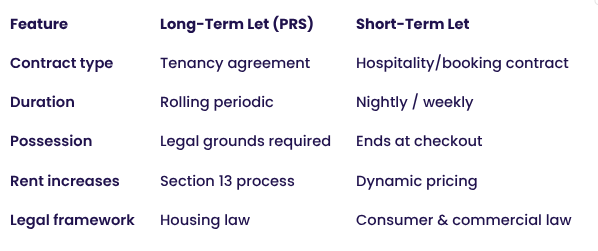
This difference in legal structure explains why many property owners consider short-term letting a more flexible operational model.
Selling a property with tenants vs short-term guests
Another practical consideration is property liquidity.
With a long-term tenant:
- Viewings may be restricted
- Tenants may refuse to leave
- Buyers may be concerned about possession risks
With short-term stays:
- Bookings naturally end
- Owners retain calendar control
- Viewings can be scheduled between stays
For some property owners, this operational flexibility is an important factor when deciding how to use their property.
Key takeaway
The Renters’ Rights Act 2025 fundamentally reshapes the UK rental market.
For traditional landlords, it introduces:
- Stronger tenant protections
• Greater legal complexity
• Longer possession timelines
For property owners evaluating their options, understanding the difference between tenancy law and hospitality-style accommodation models is now more important than ever.
Become a successful host with Pass the Keys
Have questions about the short-let market? Our host advisors are here to help you navigate the process.